
The Athena Tracker was first launched in September 2019. Since then, hundreds of secondary schools across Ireland have used the software to monitor student development and help students fulfil their own unique potential. While it is, of course, inspiring to see the software used in this way, we are always fascinated to hear the new, unusual, or slightly outside the box ways that schools are engaging with the software.
This brings us to a recent chat with seasoned educator and Athena Tracker mentor, Des Healy. Des has over thirty years 30 years of teaching experience at CBS Tralee and in the last few years has played a pivotal role in rolling out the Athena Tracker.
When we sat down with Des to discuss how he has been using the Athena Tracker, the conversation immediately veered towards some uncommon ways of using the Athena Tracker and the data it provides. Below, we share three unique uses and ways of looking at the software that other schools might not have considered.
1. Using the Athena Tracker as Part of the ‘One Good Teacher Initiative’
The ‘One Good Teacher Initiative’ is a wellbeing initiative where each student is assigned with a teacher who becomes a contact point and mentor to them. Des told us about the initiative and how Athena Tracker had become an important component of it.
“The One Good Teacher Initiative was brought in by a deputy principal who was new to the school. The guiding principle behind the initiative is that “wellbeing is an enabler of learning” and “if you are learning, that enhances wellbeing”. So there is a lovely symmetry to it all that the teachers bought into right away. Each teacher agreed to take four students under their wing and check in with them at regular intervals.
However, by the end of a busy first term, we found that there weren’t as many check-ins as we had hoped. While both the students and teachers were committed to the initiative, the real challenge was initiating the exchange and framing the conversation.
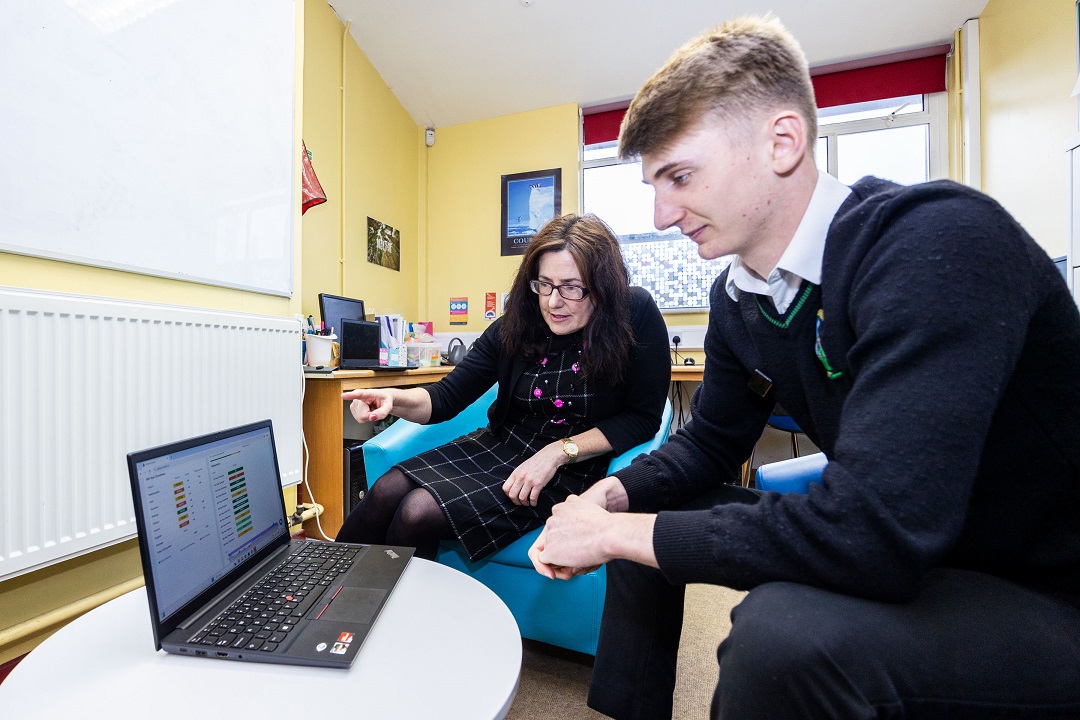
To bring structure to these wellbeing checks, we used the Athena Tracker. This provided teachers with the perfect entry point. Using the software, the teacher and student could sit down and review the student’s Athena Tracker profile together. The data is non-judgemental and objective, and the student’s story opens up in front of you as you review it. It became the ultimate ice-breaker as teachers could simply review the data and ask questions about it.
For teachers, it made the initiative much easier and the feedback from the students was that they felt more seen, heard and listened to. The Athena Tracker thus became a vital component in the initiative and one of the chief drivers of its success.”
2. Helping Students Take Responsibility and Become ‘Active Agents’ in Their Own Learning
Des has been heavily involved in his school’s improvement planning and self-evaluation programme for years. When rolling out new initiatives, Des and his colleagues often take inspiration from frameworks outlined in ‘Looking at Our School 2022: A Quality Framework for Post-Primary Schools’, as well as earlier iterations of this document.
Des spoke of two overlapping objectives that his school had related to student learning. The first is the directive that “students reflect on their progress as learners and develop a sense of ownership of, and responsibility for, their learning”. The second is the principle that “students are active agents in their learning”.
As Des outlined, a simple process involving the Athena Tracker helped the school to address these objectives.
“We ran an initiative where we asked sixth year students to set their own aspirational targets. We then asked teachers to check in with the students individually to ask them why they had set that particular target and what they were going to do, in the immediate future, to achieve it. In the notes section of the Athena Tracker, the teachers then kept a brief note of what they had said they would do to achieve their target, with the view to checking in again in eight week’s time, and seeing how well they stuck to their learning intention.
This was probably the most positive thing I did in my fifteen years of school improvement planning because of the impact it made across the board and how it pulled everyone in. This included positive feedback from students who benefitted from having one-to-one discussions and clear setting of intentions. It was hugely beneficial for teachers who learned a lot about themselves and what they were doing inside the room.
But also, it was very helpful for parents, who really engaged with this initiative. They could speak to their child about what they said they were going to do to reach their target and find out if they were sticking to their intention and the promise they had made to themselves. The parents loved the one-to-one nature of this initiative also.”
3. Turning Cold Data Into Storylines and Allowing Students to Actively Engage in Their Story
Des Healy is a maths teacher and has long been interested in student metrics and hard data. However, as Des outlined, the Athena Tracker has allowed him and his colleagues to turn cold data into stories about the student’s academic journey.
These stories have been crucial in:
- Helping teachers gain a better understanding of their students.
- Allowing students to become active agents in their learning.
- Setting expectations with parents.
“As a maths teacher, I give out a lot of exams and I was always interested in the numbers — the students’ percentage, the class average, the grade cut-off points etc.
However, these cold metrics were quickly superseded by the Athena Tracker, which wasn’t just presenting you with cold metrics, but a complete storyline.This storyline included where the student has come from, what their baseline ability was, how they have been fulfilling their own potential, what their story was when they first arrived at school, what their story is now and what direction they are heading. Everything is contained within this one page. Seeing it, you can’t help but feel connected to the student and feel empathic to their story.
A Powerful Experience for Students
“I cannot impress on you the power of showing this to a student and the effect it has on them. When you show a student their Athena profile, they see their whole story right in front of their eyes. It is not this cold metric of “67% in algebra” which, without context, is really an abstraction. Instead, they see the journey they’ve been on and what they’ve gone through.
Then, when a student sets their own aspirational targets, they are actively engaging with their story and the whole experience becomes much more inclusive. This simple reframing can shift the entire culture of the school in a much more positive direction.”
Setting Expectations With Parents
“The Athena Tracker and the storyline it provides, makes it much easier to have discussions with parents about what level their child should be pursuing as they move from junior to senior cycle.
As a maths teacher, this is especially important. A decision about pursuing honours maths for example shouldn’t be solely based on what grade they achieved in their Junior Cycle exams. Instead, the teacher can share a holistic view of the student from CAT4s to their first state exams, highlighting any trends that have been emerging and how capable they would be of pursuing a higher level. Having this detailed story makes it much easier to present your case to parents and set expectations.”
A massive thanks to Des for speaking with us and sharing some truly fascinating insight. If you’d like to learn more about Des and his mentorship programme, please visit Athena Tracker Mentorship Programme.