

Establishing Normative Fitness Data For Students in Ireland

In December 2024, Research Ireland announced funding of €4.3m that would enable 35 postgraduate and postdoctoral candidates across 13 higher education institutions to collaborate with an enterprise partner on a research project of mutual interest.

One of those rewarded scholarships was Athena FitnessMark Product Executive, Eoin Joy. Eoin is now pursuing a PhD, which focuses on the development of fitness testing battery software platforms for use in secondary school physical education. His research, which is being carried out in collaboration Athena Analytics and the University of Limerick, supports the ongoing refinement of Athena FitnessMark and aims to establish the first normative dataset on adolescent fitness levels in Ireland. 

An Interview With PhD Candidate, Eoin Joy

Recently, we caught up with Eoin to discuss his research. We started out by asking him about the overall objective of his PhD.  

Eoin: My PhD project is focused on advancing the Athena FitnessMark by aligning it with international best practices and testing its effectiveness in a real-world school setting. A key outcome will be the creation of a national database of ‘adolescent fitness norms’. Understanding adolescent fitness levels is crucial to assessing the current and future health of our country.  

Specifically, the key objectives are as follows:

  1. To conduct a scoping review of software currently used to monitor adolescent physical fitness in secondary schools around the world.

  2. To explore the existing fitness monitoring practices of Irish physical education teachers and assess their openness to adopting digital solutions for tracking fitness in adolescents.

  3. To investigate the experiences of teachers and students, who are using FitnessMark to monitor physical fitness in Irish secondary schools.

  4. To develop the first national database of physical fitness norms for adolescents in the Republic of Ireland.

  5. To assess the feasibility of implementing the FitnessMark test battery and software for HRPF (health related physical fitness) monitoring in Irish secondary schools.

How has your progress been to date?

It has been a busy first year working on my PhD and I’ve made a lot of progress so far.

The protocol for my scoping review, titled ‘Fitness Test Battery Software Platforms for Monitoring Physical Fitness Among Adolescents in Secondary Schools: A Scoping Review Protocol’, is publicly available on the Open Science Framework repository and has been accepted for publication in HRB Open Research (see bottom of post). 

We have completed both database and grey literature searches, followed by title, abstract, and full-text screening to identify systems that met our inclusion criteria. We are now engaging with a global panel of experts in adolescent fitness to review our set of included systems and highlight any additional platforms that haven’t been captured in the literature. This has been an exciting and enriching process, involving contributions from experts across the globe, from Canada and Australia to Pakistan.

The national survey that we put together on PE teachers’ use of fitness testing and their willingness to adopt digital technologies has received an overwhelming response, with over 350 teachers from 278 individual schools across Ireland participating. I am currently finalising the manuscript for publication and look forward to sharing the findings soon.

For the national study aimed at establishing normative fitness values for Irish adolescents, I have completed the sampling framework and determined the required distribution of schools based on key demographic indicators. The next phase will involve recruiting schools and commencing data collection. This project will be a major focus of my work throughout the upcoming academic year.

In terms of dissemination, I was thrilled to present preliminary findings from the national survey at the inaugural Irish Sport and Exercise Sciences Association (ISESA) National Conference in Waterford earlier this year, and more recently at the Irish Strength and Conditioning Network (ISCN) National Conference in Belfast.

How does your work with Athena FitnessMark align with your project and how are you working together to complete your research?

The entire focus of my PhD project is on the development and refinement of Athena FitnessMark in line with international best practice standards, ensuring that the software delivers maximum functionality and impact for teachers and schools. My collaboration with Athena FitnessMark is central to this work. We are working closely to co-design and enhance the platform based on research insights and user feedback. 

A core passion and objective of mine is to use FitnessMark to generate national normative fitness data for Irish adolescents, filling a critical gap that exists in Ireland but is well established in many other countries. This type of data plays a vital role in shaping public health and physical activity policy. 

FitnessMark has the potential to become a key tool for educators, researchers, and policymakers to better understand and support the health of our nation.

As part of your PhD, you intend to work with schools across Ireland. Could you tell us a little bit about that?  

Through my work with Athena, I currently engage with schools across Ireland in two main ways. Firstly, in my role as the Athena FitnessMark product executive, I support schools in their use of the FitnessMark platform. This includes delivering product demonstrations, assisting with onboarding, and providing ongoing support to ensure effective implementation. 

Secondly, I deliver Athena Health and Performance Clinics to transition year students. These on-site clinics combine practical fitness testing with engaging workshops on adolescent health, physical activity, nutrition, and the LCPE curriculum. The aim is to empower students to take ownership of their own wellbeing.

In addition to this work, my PhD research will involve working with a further 30 schools across Ireland in the coming academic year. I will conduct health and performance-related fitness testing with all participating students and collect the data using FitnessMark. 

Why do you think it’s so important for schools to monitor the fitness of their students?   

Monitoring student fitness is essential for supporting overall health, wellbeing, and academic performance. Physical fitness is linked to better mental health, reduced risk of chronic disease, and improved cognitive function. 

Schools are ideally placed to monitor these indicators consistently and act early when needed. All recently developed PE curricula in Ireland include fitness testing, highlighting its recognised value in education. Regular monitoring also allows teachers to deliver more targeted and evidence-based PE. Importantly, it contributes to national efforts to understand and improve adolescent health.  

Could you tell us a bit about the importance of establishing national normative fitness data? 

Establishing national normative fitness data is essential for understanding the current fitness levels of Irish adolescents and identifying trends over time. This data is a critical tool for informing public health and education policy, enabling evidence-based decision-making. 

Ireland is currently one of the few European countries without such data, limiting our ability to benchmark youth fitness against international standards. We are working to change that.

Thanks to Eoin for taking part in this interview. As he continues his PhD, we will check in with him at regular intervals to see how he is progressing.
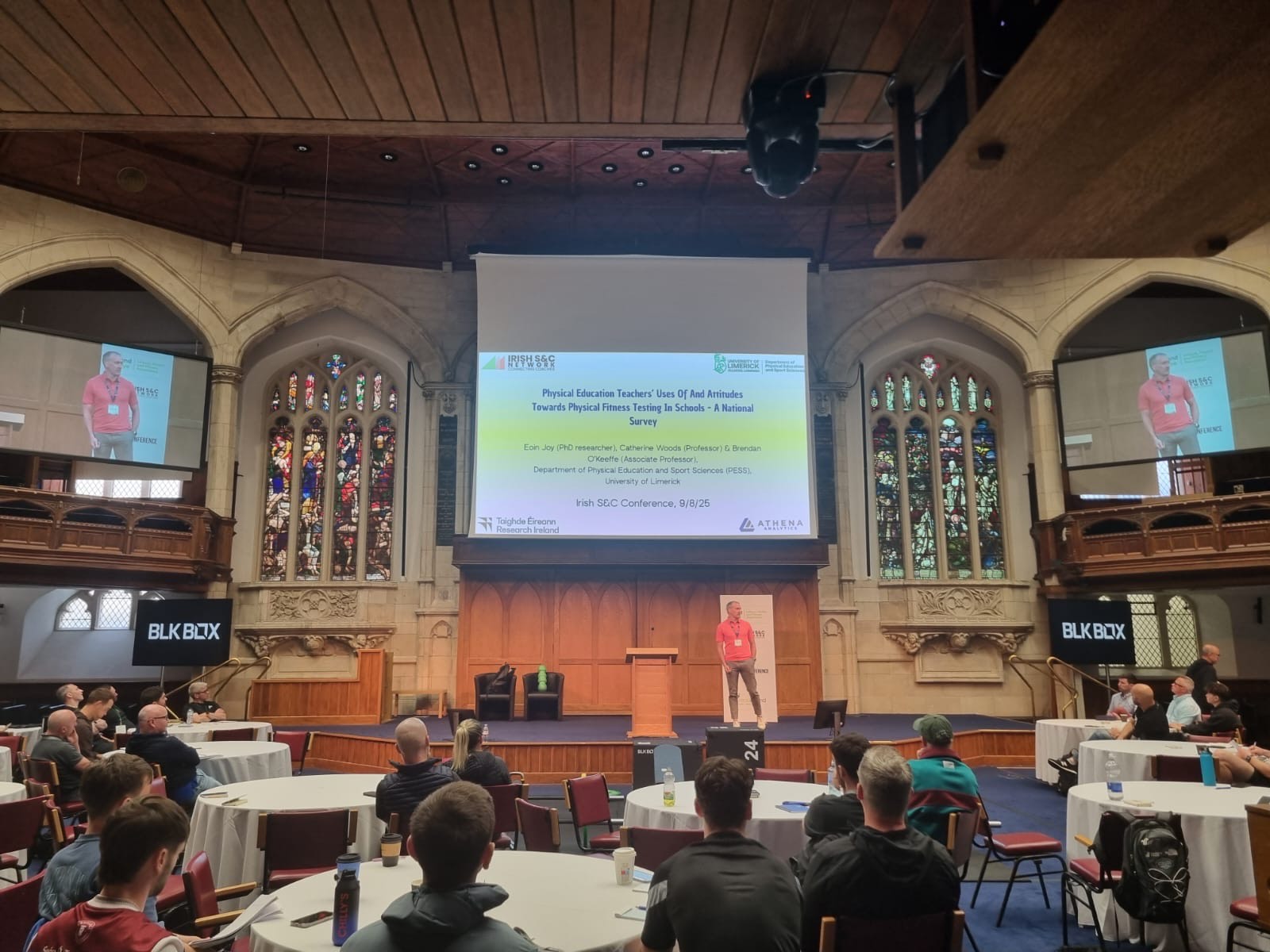
Since the interview, Eoin has celebrated two significant milestones in his PhD journey. His work “Fitness Test Battery Software Platforms for Monitoring Physical Fitness Among Adolescents in Secondary Schools: A Scoping Review Protocol” was published in HRB Open Research. 

He also recently earned the Best Research Presentation award at the Irish Strength and Conditioning Network conference in Belfast, where he presented his study “Physical education teachers’ uses of and attitudes towards physical fitness testing in schools – a national survey”.

Congratulations to Eoin on his continued success. We’re proud to be a part of his journey!