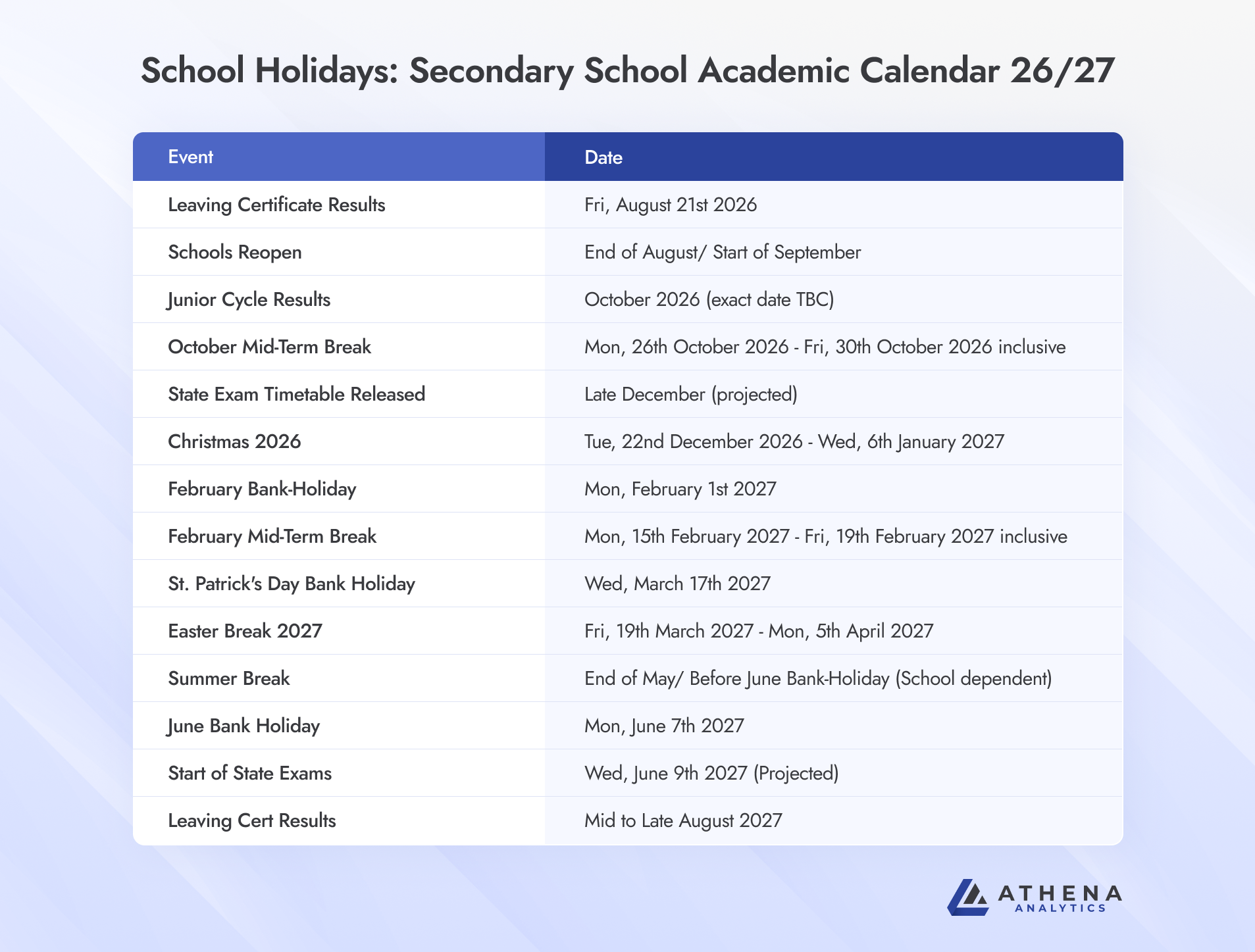

Junior Cycle 2025 exam results were released at 9am on Wednesday, 8 October 2025. (Using a brand new grading system, see here.)
For students, receiving Junior Cycle exam results is a pivotal milestone, marking the end of their first significant phase of secondary education. Many will be happy with their results, while others may be left disappointed. For schools, receiving Junior Cycle results offers an opportunity to reflect and open meaningful conversations between senior management, department heads, year heads, and subject teachers.
Schools can learn a huge amount from their Junior Cycle results, and the Athena Tracker helps schools to gain even more insight. In this blog post, we will look at five ways that the Athena Tracker is used to reflect on Junior Cycle results.
1. Contextualising Grades and Reviewing the Overall Showing of the Year Group
Each student receives their results in black and white. It says what grade they receive i.e. Distinction, Higher Merit, Merit etc. However, these results come without context so it can be difficult for senior management to reflect upon what the results actually mean.
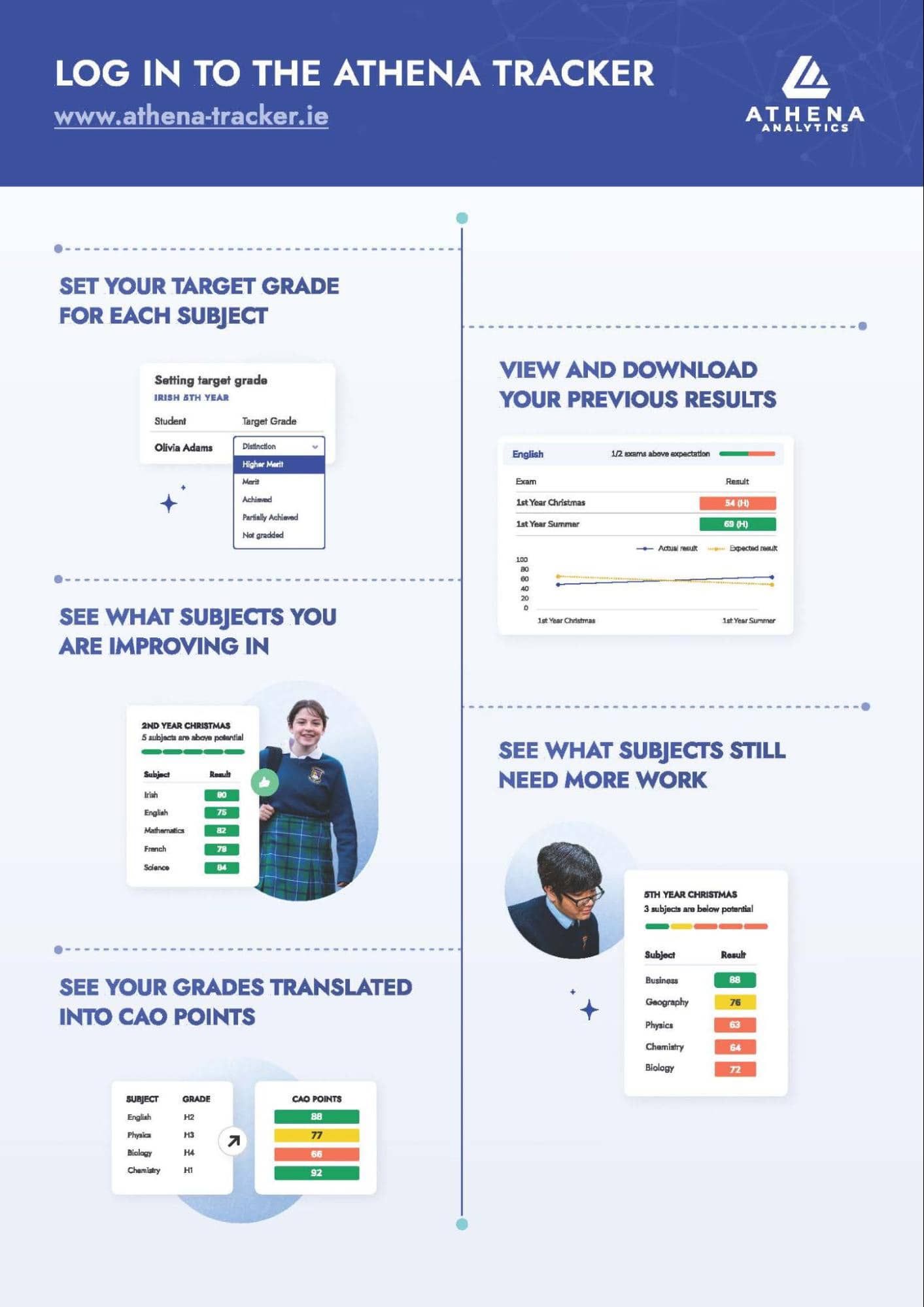
However, the Athena Tracker contextualises grades. Once a school’s Junior Cycle results are added to the Athena Tracker, senior management can see how each student performed versus their own unique potential. Instead of just seeing ‘Merits’ or ‘Higher Merits’ alone, they can see whether a student performed above, below or in line with their own unique potential. This is an altogether more appropriate measure and adds a totally new dimension to Junior Cycle results.
Seeing these results, in context, allows senior management to gauge the achievements of the entire year group. With this data at hand, they can then start important conversations with the various subject departments, celebrating success and seeing what adjustments can be made to help more students reach their own individual potential.
2. Reflecting on Results as a Subject Teacher
Subject teachers can use Junior Cycle results as an opportunity to assess how their class group performed in a given year. They can see how many students performed above, below or in line with their potential.
Year on year, this provides subject departments with the opportunity to open up meaningful, data-driven conversations and see what areas may need to be improved upon for the year ahead. With each year, the overall objective is to help more students reach their own unique potential in a given subject.

3. Getting to Know the New Senior Cycle Students
While the Junior Cycle results provide subject teachers with the opportunity to analyse the achievements of their students and make adjustments, they can also be incredibly useful for senior cycle teachers who have inherited a new class group.
Senior cycle teachers can use the Junior Cycle results to quickly get to know their students from an academic perspective. They can see how they performed and familiarise themselves with their students, based on the most recent state exam. This can greatly reduce what can be a steep learning curve for new teachers.

4. Putting Interventions in Place and Opening Conversations With Senior Cycle Students
A school can learn a huge amount by analysing their Leaving Certificate results. They can compare results with the national database, find out which subjects they are lagging behind in and what areas may need improvement. However, as sixth year students move on to the next phase of their life, it is typically the end of the line when it comes to student communication and development.
However, this is not the case with Junior Cycle results, as students progress from the junior to senior cycle. Schools can therefore use the Junior Cycle results as an opportunity to help students develop further and learn from their previous experiences. This could include conversations around subject choices for the senior cycle, based on their demonstrated aptitude for certain subject types. These conversations can be the perfect launchpad for a promising Leaving Certificate cycle.
This is where the ‘Expectation Summary’ feature within the Athena Tracker is particularly useful. The Expectation Summary provides a list of students who have completed a given exam block (in this case, the Junior Cycle exam), along with the number of subjects that they performed below, above or in line with their potential. A school can then use a filter to quickly gain a list of students who fell below their potential in a number of subjects.
With this list at hand, Year Heads and Senior Management can reach out to various students as they progress into senior cycle, putting additional support in place where necessary.
5. Reflecting Upon Aspirational Target Grades
When reviewing Junior Cycle results, it is not just the baseline potential metrics that provide an additional degree of context. Throughout the junior cycle, subject teachers, year heads, and guidance counsellors may set aspirational targets for each student. Often these aspirational targets are student led.
Once they have received their Junior Cycle results, a school can reflect upon these targets. Schools may find discrepancies between aspirational grades and actual results, or between aspirational grades and baseline potential. They may find that some students were setting their targets too high and placing undue pressure on themselves. Or they might discover that students who may have been disappointed with their results, actually achieved what they set out to achieve, and that their results are a cause for celebration.
Whatever the case may be, each learning is an opportunity for further growth.